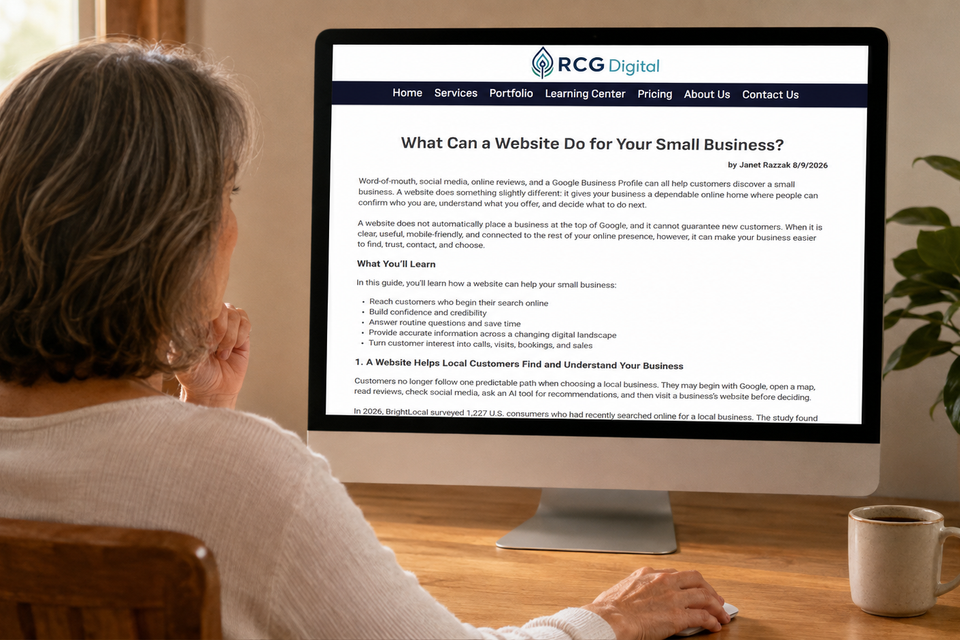
RCG Guide: What Can a Website Do for Your Small Business? by Janet Razzak
What Can a Website Do for Your Business?
by Janet Razzak 8/9/2026
Word-of-mouth, social media, online reviews, and a Google Business Profile can all help customers discover a small business. A website does something slightly different: it gives your business a dependable online home where people can confirm who you are, understand what you offer, and decide what to do next.
A website does not automatically place a business at the top of Google, and it cannot guarantee new customers. When it is clear, useful, mobile-friendly, and connected to the rest of your online presence, however, it can make your business easier to find, trust, contact, and choose.
What You’ll Learn
In this guide, you’ll learn how a website can help your small business:
Reach customers who begin their search online
Build confidence and credibility
Answer routine questions and save time
Provide accurate information across a changing digital landscape
Turn customer interest into calls, visits, bookings, and sales
1. A Website Helps Local Customers Find and Understand Your Business
Customers no longer follow one predictable path when choosing a local business. They may begin with Google, open a map, read reviews, check social media, ask an AI tool for recommendations, and then visit a business’s website before deciding.
In 2026, BrightLocal surveyed 1,227 U.S. consumers who had recently searched online for a local business. The study found that:
84% had searched online for a local business within the previous three months.
73% began their most recent local search on a mobile phone.
75% used more than one channel during that search.
Google remained the most common starting point, but it was not the entire journey. Social media, review sites, maps, and AI tools also played a part. Your website gives all of those channels somewhere reliable to lead.
A website can also help search engines understand your business. Pages that clearly explain your services, location, hours, and areas served give Google more useful information to crawl and index. This does not guarantee a particular ranking, but it creates a stronger foundation for search visibility.
What this means for your business: Your website should work well on a phone and quickly explain what you do, whom you serve, where you work, and how someone can reach you.
2. A Professional Website Builds Credibility
When a prospective customer discovers a business, one of the first questions is often, “Can I trust them?” Your website helps answer that question before you ever speak.
In a 2025 Clutch survey of 263 U.S. consumers who were household decision-makers, 83% said they judged a website’s credibility within 20 seconds. The same study found that 65% distrusted websites containing grammar mistakes, typos, or unfinished placeholder text.
Professional does not have to mean complicated or expensive-looking. It means that the website feels cared for. The information is accurate. The pages are easy to navigate. The design works on mobile devices. The contact information is visible. Links and forms work. The connection is secure.
A neglected website can create doubt, but a clear and current one reassures visitors that there is a real business—and real people—behind it.
What this means for your business: Before adding elaborate features, make sure the essentials are strong: accurate information, readable text, clear navigation, secure browsing, working links, and an easy way to contact you.
3. A Website Saves Time and Makes Customer Service Easier
Small business owners answer many of the same questions repeatedly:
What are your hours?
Where are you located?
Do you serve my area?
What services do you provide?
How much does it cost?
How can I schedule, order, or request a quote?
A website can answer those questions even when you are busy, closed, or unable to pick up the phone. Depending on your business, it can display a menu, explain a service process, collect an inquiry, accept a booking, share policies, or direct a customer to the right next step.
The website will not replace personal service. It supports it by giving customers a useful starting point and helping serious prospects arrive better informed.
What this means for your business: Think about the questions customers ask most often. Each good answer can become useful website content that saves time for both you and your customers.
4. A Website Gives Customers a Reliable Source of Information
Your business may be mentioned across Google, Facebook, Instagram, Yelp, directories, community pages, and AI-generated answers. Those platforms are valuable, but they can contain incomplete, outdated, or inconsistent information.
Your website is the place where you can publish the most complete version of your business information. You can update your services, introduce your team, explain changes, share announcements, correct misunderstandings, and show customers what makes your business different.
This does not mean that a website lets you control everything people say about your business. Reviews and public conversations will still happen elsewhere. What the website gives you is an official place to communicate clearly in your own voice.
That active presence matters. BrightLocal’s 2026 consumer research found that 96% of consumers considered it important for local businesses to actively manage how they appear online, and one-third called it essential. What this means for your business: Treat your website, Google Business Profile, social pages, and directory listings as connected parts of one presence. Keep important details consistent and use your website as the central source.
5. A Website Can Support Leads and Sales
A business does not need to sell products online for its website to contribute to revenue. A service business can generate quote requests. A restaurant can guide customers to its menu or reservations. A salon can accept appointments. A contractor can display completed projects. A retailer can help customers confirm what is available before visiting.
The website’s role is to make the next step clear and easy.
That matters because customer research often continues after a business receives a positive review. BrightLocal’s 2026 Local Consumer Review Survey found that 54% of consumers visited a business’s website after reading positive reviews.
The same year, BrightLocal asked consumers what most influenced the local business they ultimately contacted or visited. Clear and complete information ranked first at 32%, followed closely by strong reviews at 30% and clear pricing or offers at 29%. A professional-looking website also influenced 20% of respondents.
A website cannot guarantee growth. It can, however, reduce the uncertainty and friction that cause interested customers to leave without calling, booking, visiting, or buying.
What this means for your business: Every important page should lead naturally to an action—call, email, request a quote, book, order, visit, or learn more.
Your Website Works Best as Part of a Larger Online Presence
A website is not a replacement for your Google Business Profile, social media, reviews, or community relationships. Those channels can help people discover and discuss your business. Your website brings the pieces together.
Think of it this way:
Search and maps help customers find you.
Reviews and social media help customers learn what others think about you.
Your website helps customers understand you and take the next step.
When those pieces support one another, customers receive a clearer and more consistent picture of your business.
Key Takeaways
Customers use several online channels when choosing local businesses, and a website gives those channels a reliable destination.
A professional website builds trust through clarity, accuracy, security, and usability—not unnecessary complexity.
Helpful website content can answer routine questions and make customer service more efficient.
Your website gives your business an official place to communicate in its own voice.
A clear call to action can turn interest into a phone call, inquiry, booking, visit, or sale.
A Thought to Grow On
Your website does not need to be the loudest place online. It needs to be the place where uncertainty becomes confidence—and where a curious visitor can see a clear path forward.